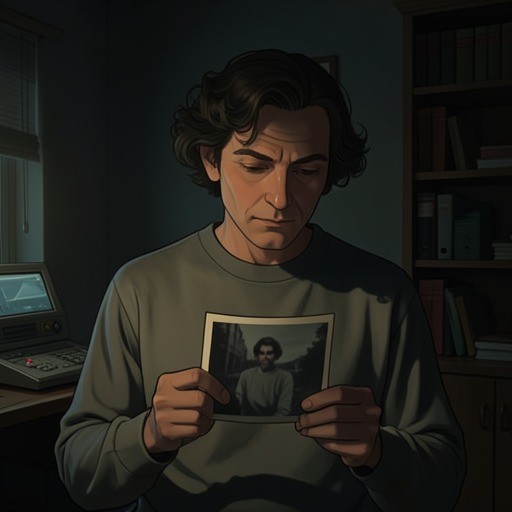
Photograph of the man Louise kept
Maigret and the Dead GirlThe Photograph of the man Louise kept is a faded, dog-eared portrait carried by Louise Laboine and taken from her mother. Its importance lies in the tension between its worn, intimate presence and its investigative force: the image preserves a connection Louise did not explain, yet helps Maigret identify a man whose name can redirect the case. The photograph is not merely an illustration of her past; it is a small, portable piece of evidence that has survived when the people and relationships around it remain difficult to recover.
Appearance and Provenance
The photograph was in a shabby notebook inside Louise’s bag. The bag also held money, lipstick, powder, a handkerchief, and two keys: one to the front door of her flat, given to her by the woman describing the contents, and one to her suitcase. The portrait’s placement among these ordinary necessities gives it a particular intimacy. It travels with the things Louise used and needed, not as a formal document displayed for others but as something retained among private possessions.
The witness described the image as at least fifteen years old, faded, and dog-eared. It showed a man of about forty, handsome and distinguished-looking, wearing a very light-colored suit that might have been linen. A palm tree stood behind him. The witness associated that background with Nice, where she had often seen such trees; this was an impression prompted by the picture, not a confirmed account of where it had been taken. The portrait therefore offers visual particulars while withholding a secure setting. Its aging surface suggests long keeping, but it cannot by itself explain when or why Louise carried it.
The Man in the Portrait
When Maigret asked about the photograph, the witness first clarified that it showed a man, while cautioning against the assumptions the image might invite. She saw no likeness between him and Louise. If he was Louise’s father, she thought, Louise had not inherited his appearance. The portrait thus raised a question of kinship without resolving it through resemblance; its significance depended on information beyond the face itself.
The witness’s later account connected the image to Louise’s mother’s former husband. Asked whether Louise’s mother had shown her a photograph of that man, the witness said she had asked to see one and had been told there was only a single photograph. The former husband had avoided photographers, and his picture had been taken without his knowledge. The witness believed Louise must have taken it with her to Paris, since it disappeared when she left. That history makes the portrait’s survival exceptional: it was apparently the only image the mother had of a man who had kept himself away from cameras, and it passed into Louise’s possession.
From Keepsake to Clue
The crucial change comes when Maigret understands whose photograph Louise had taken and kept so carefully. The portrait moves from a puzzling item in a bag to a clue that supplies a name and gives the investigation a new direction. Its worn condition and private history matter, but the decisive value is relational: it links Louise to a man through the image and through the act of taking it from her mother. The picture cannot establish everything about their relationship on its own; its force comes from the testimony about its origin and from Maigret’s recognition of the man’s identity.
That recognition also alters Maigret’s immediate sense of the investigation. Lognon is pursuing a clue alone, while Maigret has the resources of Headquarters and the wider police organization available to him. Knowing the man’s name gives Maigret work to do at the Quai des Orfèvres, and he responds to the thought by pouring himself a small glass of plum brandy. The photograph’s consequence is therefore practical as well as interpretive: it turns a seemingly minor personal possession into a lead worth taking back to police headquarters.
Photographs and Recognition
The portrait belongs to a wider pattern in which photographs make people visible without making them fully understood. The evening papers reproduce the same photograph of the dead Louise that had appeared in the morning papers. Later, professional proofs show her as she might have looked when she entered Mademoiselle Irène’s shop, rather than as a bruised body seen under flashlights or on a slab at the Medico-Legal Institute. Those images invite recognition, but the portrait of the man works differently: it is old, private, and connected to a history Louise carried without publicly explaining it.
The contrast sharpens the object’s role. Louise’s published image circulates widely, yet her former existence seems nearly forgotten; the private portrait circulates only through her own keeping and another person’s recollection, yet it enables Maigret to pursue a specific identity. One photograph confronts the public with a dead woman who is hard to place; the other helps investigators place her within a concealed family history. In both cases, an image offers evidence but not a complete account. The worn portrait matters because someone kept it, someone remembered where it came from, and Maigret could connect its face to a name.